
The entrepreneur who starts a business is rarely the same person who scales it to market leadership. The spreadsheet that tracks your first sales won't manage your thousandth customer. The hiring process that brought in your founding team won't build your scaled organization. Why? Because leadership must evolve through distinct phases, each requiring different capabilities, mindsets, and systems.
This isn't a failure of vision or talent—it's the natural progression of organizational growth. Yet most leaders struggle through these transitions without a map, repeating expensive mistakes that could be avoided with the right sensemaking framework. They hire consultants who prescribe solutions designed for different growth stages. They implement systems their organization isn't ready for. They scale too fast—or too slow—and burn out teams in the process.
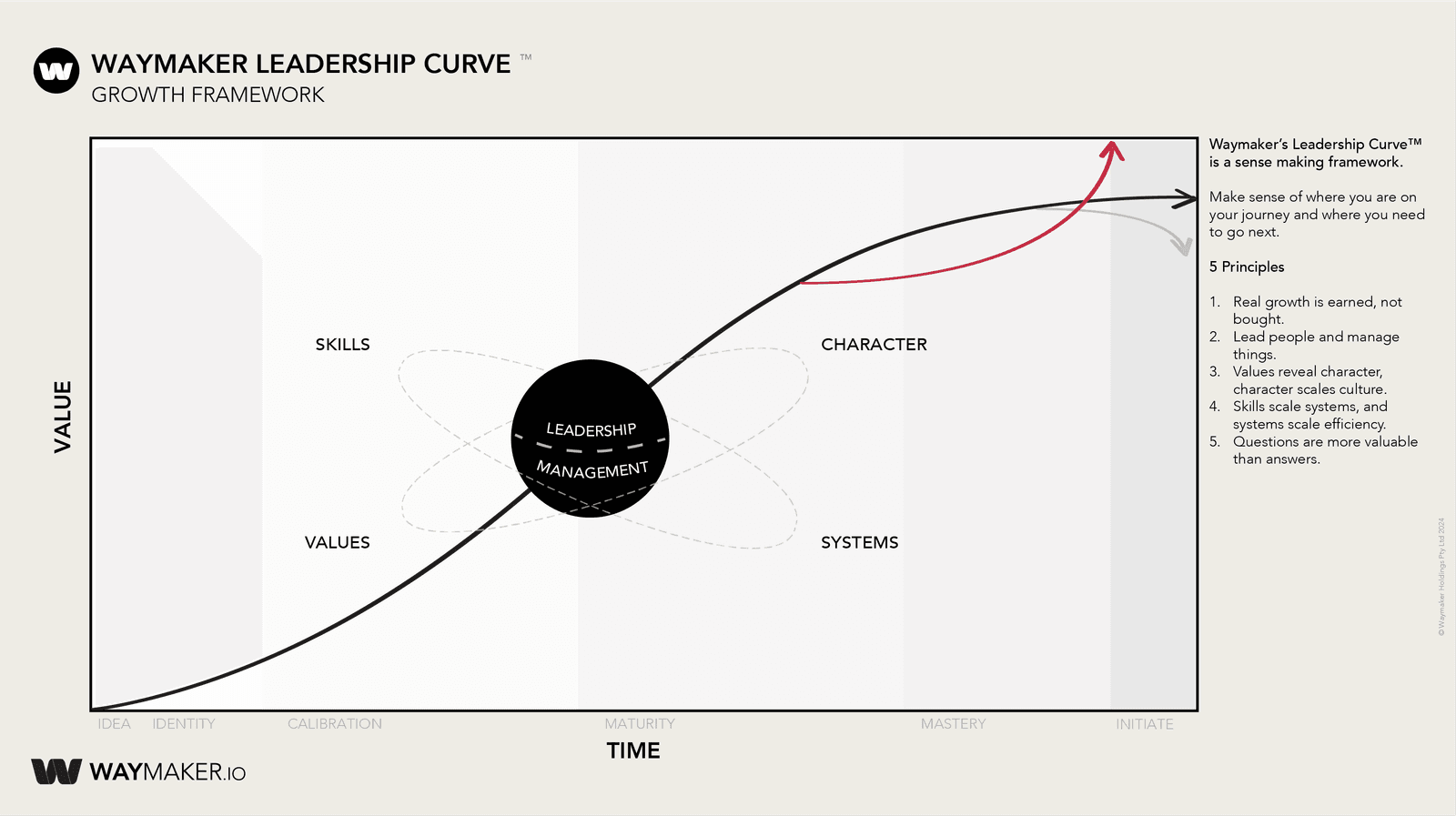
The Waymaker Leadership Curve provides that map. It's a framework for understanding where your organization is today, what capabilities you need to develop, and how to navigate the transition to your next phase of growth. Built on five foundational principles and tested across 500+ businesses over 15 years, it turns leadership evolution from guesswork into deliberate practice.
The Problem: Leading Without a Compass
Most business failures aren't caused by bad products or insufficient capital. They're caused by leadership that hasn't evolved to match organizational needs.
Consider the classic startup trajectory: a charismatic founder builds something people want, attracts early customers through force of personality, and grows revenue to $1-2M annually. Then growth stalls. The systems that worked for 10 customers break at 100. The culture that emerged organically fragments as teams grow. The founder who thrived in chaos struggles with the order required to scale.
According to Harvard Business Review research on scaling startups, most companies fail to scale beyond their initial success not because they lack opportunity, but because leadership capabilities don't evolve with organizational complexity.
The symptoms are familiar:
- Decision bottlenecks as founders remain the single point of approval
- Culture erosion as values that were implicit become unclear at scale
- Talent mismatch as early employees struggle with specialized roles
- System chaos as informal processes can't handle increased volume
- Strategic drift as tactical firefighting replaces long-term planning
Each symptom points to the same root cause: the organization has entered a new phase, but leadership hasn't made the transition.
The Cost of Phase Mismatch
When leadership doesn't match organizational phase, the financial impact is severe.
Example: Series A Startup ($3M ARR)
- Leadership operating in "Identity" mode (founder-centric decisions)
- Organization needs "Market Fit" leadership (systems and delegation)
- Result:
- 40% of founder's time on decisions others should make = 16 hours/week
- Customer acquisition cost 3x higher due to lack of repeatable process
- Employee turnover 35% annually from unclear expectations
- Growth rate: 20% (should be 100%+ at this stage)
Total opportunity cost: $1.2M in unrealized revenue, $300K in recruitment costs, and 18 months of stalled progress.
The math is brutal. But here's what makes it worse: these companies don't know they're experiencing phase mismatch. They attribute problems to talent, market conditions, or product-market fit—when the real issue is that leadership capabilities haven't evolved to match organizational needs.
What the Waymaker Leadership Curve Actually Is
The Waymaker Leadership Curve is a sensemaking framework that maps the journey from organizational chaos to sustainable order through four distinct growth phases.
"Sensemaking" might sound academic, but it's intensely practical. Karl Weick's research on sensemaking in organizations describes it as the process of understanding and interpreting complexity so you can make informed decisions. Think of it like climbing a tree in a dense forest—you need elevation to see the landscape, identify landmarks, and choose the right path forward.
That's what the Leadership Curve provides: elevation to see where your organization is, what's required to thrive in your current phase, and what capabilities you need for the next one.
The fundamental shift is profound:
- Traditional Growth Models: "Scale fast, hire more, increase revenue"
- Leadership Curve Approach: "Develop capabilities that match your phase, then earn the transition to the next"
Here's a concrete analogy: You wouldn't put a 5-year-old in an Olympic training program. The child lacks the physical development, emotional maturity, and foundational skills required. Forcing premature intensity doesn't accelerate growth—it causes injury and burnout.
Organizations are the same. Implementing enterprise systems when you're still finding product-market fit doesn't accelerate growth—it creates complexity you're not ready to manage. Hiring a VP of Sales before you have a repeatable sales process doesn't scale revenue—it wastes capital and damages morale.
The Leadership Curve helps you match interventions to maturity, ensuring each phase builds the foundations needed for the next.
The Four Phases: From Chaos to Order
Explore the complete Waymaker Leadership Curve framework below. Each phase represents a distinct stage of organizational development with specific leadership requirements, challenges, and transition points.
Phase 1: Identity Formation
What it is: Establishing core values, initial market understanding, and foundational character that will guide all future decisions.
Why it matters: Your identity determines what opportunities you pursue, who you hire, and how you make decisions under pressure. Get this wrong, and you'll pivot endlessly without direction.
Without Identity Formation: A consulting firm accepts any client willing to pay → No specialized expertise develops → Can't charge premium rates → Perpetual revenue instability → Founder burnout after 3 years.
With Identity Formation: A consulting firm defines "We serve manufacturing companies navigating digital transformation" → Develops deep expertise → Earns reputation and referrals → Commands 3x market rates → Sustainable, focused growth.
Key Activities:
- Define core values that will remain constant through all growth phases
- Establish character foundation that shapes culture at scale
- Validate initial market hypotheses through real customer engagement
- Build minimum viable product or service offering
- Create foundational systems (basic financials, simple CRM, core processes)
Leadership Challenge: Resisting the temptation to be everything to everyone. Identity requires exclusion—deliberately choosing what you won't do so you can excel at what you will.
Common Mistakes:
- Values as aspirational platitudes rather than decision-making filters
- Chasing revenue without strategic focus
- Building features before validating core value proposition
- Scaling team before culture is defined
Transition Indicator: You've completed Identity Formation when you can clearly articulate who you serve, what unique value you provide, and what principles guide every decision—and when early customers validate this focus through repeat business and referrals.
Learn more about establishing resolute leadership foundations in Resolute Leadership vs Charismatic Leadership.
Phase 2: Market Fit
What it is: Achieving product-market alignment where your offering consistently solves a real problem that customers will pay for, and establishing repeatable processes to deliver that value.
Why it matters: Identity tells you who you are. Market Fit proves the market agrees. Without this validation, scaling just accelerates cash burn.
Without Market Fit: A SaaS company raises $2M and scales the team to 20 people → Builds features customers don't use → Customer acquisition cost exceeds lifetime value → Runs out of runway → Shuts down having never found product-market fit.
With Market Fit: A SaaS company proves customers will pay for core value proposition → Validates pricing through real sales → Establishes repeatable acquisition process → Scales team and capital efficiently → Reaches profitability, then scales.
Key Activities:
- Validate pricing and business model through actual sales (not prototypes)
- Establish repeatable customer acquisition process
- Develop standardized delivery/fulfillment systems
- Create feedback loops to understand what's working and why
- Document core processes so others can execute them
- Build early team with complementary skills
Leadership Challenge: Balancing customer feedback (which demands responsiveness) with strategic focus (which demands discipline). Not every customer request should become a feature.
Common Mistakes:
- Confusing "traction" with true market fit (vanity metrics vs. unit economics)
- Scaling the team before proving repeatable customer acquisition
- Custom solutions for each customer instead of standardizing value delivery
- Premature automation before manual processes are proven
- Pivoting too quickly when obstacles emerge
Transition Indicator: You've achieved Market Fit when customer acquisition cost is predictable, lifetime value exceeds acquisition cost by 3x+, customer retention is strong, and you have documented processes that new team members can execute successfully.
Discover why sustainable growth must be earned through maturity stages in Real Growth is Earned, Not Bought.
Phase 3: Calibration
What it is: Aligning team capabilities, organizational systems, and cultural practices with the demands of scaled operations. Building the infrastructure that supports growth beyond founder dependence.
Why it matters: Market Fit proves you can grow. Calibration ensures you can sustain and scale that growth without breaking systems, culture, or people.
Without Calibration: A services firm grows to $5M revenue with 30 employees → All decisions still flow through founder → Quality becomes inconsistent → Top performers leave due to lack of clear career paths → Culture fragments into departmental silos → Revenue plateaus, founder burns out.
With Calibration: The same firm implements clear decision frameworks → Develops leaders who can own business units → Standardizes quality through documented systems → Creates career progression paths → Culture scales through intentional practices → Revenue grows to $15M with manageable founder workload.
Key Activities:
- Develop leaders who can make decisions without founder approval
- Implement systems that ensure quality regardless of who executes
- Standardize operations while preserving cultural values
- Create career progression frameworks to retain top talent
- Establish metrics and dashboards for real-time performance visibility
- Document and improve core processes across all functions
- Align departmental goals with overall organizational strategy
Leadership Challenge: Letting go. Founders must transition from doing the work to developing people who do the work. This requires trust, systems, and tolerance for mistakes as others learn.
Common Mistakes:
- Hiring executives from larger companies who bring enterprise complexity too early
- Implementing systems that create bureaucracy without improving outcomes
- Scaling headcount without clarifying roles and decision rights
- Preserving "startup culture" in ways that prevent necessary maturity
- Resisting specialization because "everyone should wear multiple hats"
Transition Indicator: You've completed Calibration when leaders throughout the organization make good decisions autonomously, systems ensure quality and efficiency at scale, culture remains strong as headcount grows, and the business can operate effectively when the founder is absent for extended periods.
Understand the critical distinction between leadership and management in Lead People, Manage Things.
Phase 4: Scaling
What it is: Expanding market reach, geographic footprint, or product lines while maintaining the quality, culture, and unit economics established in earlier phases.
Why it matters: Scaling isn't just "doing more of the same." It requires maintaining excellence while navigating new complexity: multiple markets, regulatory environments, competitive dynamics, and organizational layers.
Without Scaling Leadership: A successful regional business expands nationally → Replicates systems that worked locally → Discovers they don't translate across geographies → Quality varies by location → Brand reputation suffers → Retreats to core market, damaged and demoralized.
With Scaling Leadership: The business documents what made regional success work → Identifies which elements are universal vs. locally adapted → Pilots expansion with small tests → Iterates based on learning → Scales proven models systematically → National expansion succeeds while preserving quality and culture.
Key Activities:
- Identify scalable vs. non-scalable elements of your model
- Develop regional or vertical-specific adaptations while maintaining brand consistency
- Build multi-layered leadership capable of autonomous operation
- Implement advanced systems for forecasting, analytics, and optimization
- Create innovation frameworks that don't disrupt core operations
- Establish governance structures that balance autonomy with alignment
- Expand strategic partnerships and ecosystem relationships
Leadership Challenge: Maintaining identity and values while adapting to new contexts. What got you here won't get you there—but abandoning core principles in pursuit of scale destroys what made you successful.
Common Mistakes:
- Scaling before achieving true calibration (premature expansion)
- Assuming what works in one market will work everywhere
- Losing sight of unit economics in pursuit of growth metrics
- Allowing culture to become diluted as the organization expands
- Over-centralizing decisions or over-distributing without frameworks
Transition Indicator: You've successfully transitioned to Scaling when you can enter new markets or product categories with predictable success rates, maintain consistent quality and culture across locations, sustain healthy unit economics at increased volume, and develop leaders who can lead expansion independently.
Explore how values and character create scalable culture in Values Reveal Character, Character Scales Culture.
The Two Pillars: Character/Values and Skills/Systems
Throughout every phase of the Leadership Curve, two elements remain constant in what they are, while evolving in how they're applied:
Character and Values: The Unchanging Foundation
What they are: The moral character of leadership and the core values that guide decision-making. These don't change based on growth phase.
Why they matter: In a VUCA world (volatile, uncertain, complex, ambiguous), character and values provide the stability needed to navigate chaos. They're the "true north" when everything else is shifting.
Examples:
- Integrity: You don't lie to customers in Phase 1, and you don't lie to investors in Phase 4
- Customer focus: You prioritize customer value when you're small, and when you're large
- Excellence: Quality matters at 10 customers and at 10,000 customers
In Practice:
- Phase 1: Founders embody values personally in every interaction
- Phase 2: Values become hiring filters and decision frameworks
- Phase 3: Values are codified into systems and onboarding processes
- Phase 4: Values define brand identity and are maintained through governance
Skills and Systems: The Adaptive Tools
What they are: The specific capabilities (skills) and organizational frameworks (systems) that enable execution. These must evolve through each phase.
Why they matter: Skills and systems that work for 10 people break at 100 people. What scales efficiency at one phase creates bottlenecks at the next.
Examples:
- Phase 1: Founder does sales personally (skill: direct selling | system: spreadsheet)
- Phase 2: Sales team executes repeatable process (skill: process execution | system: basic CRM)
- Phase 3: Sales managers lead teams with clear metrics (skill: team leadership | system: sales stack with analytics)
- Phase 4: Regional sales VPs manage multi-market operations (skill: strategic sales leadership | system: enterprise CRM with forecasting)
The Critical Balance: Character and values stay the same—they're your foundation. Skills and systems must change—they're your adaptation to increasing complexity.
This is what makes resolute leadership different from charismatic leadership. Charismatic leaders rely on personal appeal (which doesn't scale). Resolute leaders build on character (unchanging) while developing skills and systems (adaptive) at each phase.
The 12 Questions Framework: Navigating Each Phase
At each phase of the Leadership Curve, leaders must answer 12 critical questions:
The 5 Management Questions (Managing Things)
- "What is our plan, and what metrics tell us if we are successful?" Learn the Plan Canvas framework
- "What roles does our plan require, and who is accountable for what parts?"
- "What goals and outcomes must each role achieve this quarter, half, or year?"
- "What meetings are necessary, what should we discuss, and how do we solve problems together?"
- "What data do we need to measure our progress and ensure success?"
The 7 Leadership Questions (Leading People)
- "What is our vision, is it driven by our purpose, and what is holding us back from reaching it?" Discover the Vision Canvas
- "What is our market, who is our ideal customer, what do they value, and what perceptions do we need to build?" Explore market positioning
- "What is our strategy, where is our growth focused, and how do we improve our positioning?"
- "What is our business model, is it creating value, what metrics tell us this, and what practices improve our value proposition?" Validate your model
- "What is our customer's experience, how do we acquire, retain, and grow customers through our journey & promise, and what improvements need to be made?" Design your CX strategy
- "What is our employee's experience, how do we acquire, retain, and grow talent through our journey & promise, and what improvements need to be made?" Build employee experience
- "What are the one, two, or three things that, if delivered in the quarter or half, will shift the needle on the business?"
The power of questions over answers: In a VUCA environment, the questions you ask matter more than the answers you have. Good questions reveal assumptions, uncover blind spots, and adapt to changing circumstances while maintaining strategic focus.
As your organization moves through phases, the 12 Questions remain the same—but the depth and sophistication of your answers must evolve.
Explore the complete framework in The 12 Questions Every Leader Must Answer.
Tools for Clarity: The Canvas Methodology
Answering the 12 Questions requires a structured thinking process. That's where Clarity Canvases come in.
Each canvas facilitates divergent thinking (exploring possibilities widely) followed by convergent thinking (synthesizing insights into clarity statements). It's design thinking applied to business strategy.
The Process:
- Divergent Phase: Use the canvas to explore questions broadly (What are all the possibilities? What are we missing?)
- Convergent Phase: Synthesize insights into a Clarity Statement (What's the clear path forward?)
- Execution Phase: Turn clarity into action with defined metrics and accountability
Example: Vision Canvas
- Divergent: What are 10 different versions of our long-term vision? What barriers exist to each? What would breakthrough look like?
- Convergent: Our vision is [specific future state] that overcomes [key barrier] through [strategic approach]
- Execution: We'll measure progress through [3 key metrics] with quarterly milestones
Learn the complete canvas methodology in Clarity Canvases: The Workshop Tool for Strategic Clarity and understand the divergent-to-convergent process in From Divergent to Convergent: Design Thinking for Business Strategy.
Self-Assessment: Where Are You on the Leadership Curve?
Use this framework to identify your current phase and readiness for transition:
Phase 1: Identity Formation
✅ Core values are defined and guide all decisions ✅ Initial market focus is clear and validated by early customers ✅ Foundational character/culture is established ✅ Basic systems exist (financials, customer management) ✅ Product/service delivers clear value to target customers
If 3+ are incomplete: You're still forming identity. Focus here before scaling.
Phase 2: Market Fit
✅ Customer acquisition cost is predictable and sustainable ✅ Lifetime value exceeds acquisition cost by 3x+ ✅ Repeatable processes exist for sales and delivery ✅ Customer retention rates are strong (>80% annually for B2B) ✅ Team can execute core processes without founder involvement
If 3+ are incomplete: You haven't achieved market fit. Don't scale yet.
Phase 3: Calibration
✅ Leaders throughout organization make good decisions autonomously ✅ Systems ensure quality regardless of who executes ✅ Culture remains strong as headcount grows ✅ Career progression paths retain top talent ✅ Business operates effectively when founder is absent
If 3+ are incomplete: You need calibration before expanding markets.
Phase 4: Scaling
✅ Can enter new markets with predictable success ✅ Quality and culture are consistent across locations ✅ Unit economics remain healthy at increased scale ✅ Multi-layered leadership operates autonomously ✅ Innovation happens without disrupting core operations
If 3+ are incomplete: Focus on calibration before aggressive expansion.
The most common mistake: Trying to scale (Phase 4) before achieving calibration (Phase 3) or even market fit (Phase 2). This is like building the upper floors of a building before the foundation has cured—it collapses under its own weight.
Real-World Impact: The Cost of Phase-Appropriate Leadership
Let's quantify the financial impact of phase-appropriate vs. phase-mismatched leadership.
Phase Mismatch Example: Series B SaaS Company
Situation: $10M ARR, 50 employees, raised $15M Series B Phase Reality: Late Phase 2 (Market Fit) with some Phase 3 (Calibration) elements Leadership Approach: Phase 4 (Scaling) — "Time to aggressively expand"
Phase 4 Actions Taken:
- Hired VP of Sales from enterprise company ($250K + equity)
- Expanded to 3 new markets simultaneously
- Built enterprise features before mid-market product was solid
- Scaled team to 100 people in 12 months
- Implemented Salesforce Enterprise, NetSuite, enterprise HR systems
Results After 18 Months:
- Cash burn: $2M/month (was $800K before scaling)
- ARR growth: $10M → $14M (40% vs. projected 200%)
- CAC: Increased 4x due to unvalidated markets
- Churn: Increased to 25% annually as enterprise features disrupted core product
- Employee turnover: 45% as systems created chaos, not clarity
- Remaining runway: 8 months before Series C or shutdown
Total Cost: $24M burned to gain $4M in ARR = $6 CAC for every $1 of ARR
Phase-Appropriate Alternative: Same Company, Different Approach
Phase 2/3 Actions Taken:
- Validated one new market with pilot customers before scaling ($50K investment)
- Hired sales manager from similar-stage company ($150K + equity)
- Improved mid-market product based on customer feedback
- Scaled team to 70 people over 18 months (measured growth)
- Implemented mid-market appropriate systems (HubSpot, QuickBooks, Rippling)
Results After 18 Months:
- Cash burn: $1.2M/month (controlled growth)
- ARR growth: $10M → $22M (120% through focus)
- CAC: Decreased 20% through refined targeting
- Churn: Reduced to 12% through product improvements
- Employee turnover: 18% (healthy for growth stage)
- Remaining runway: 36 months with path to profitability
Total Value: $21.6M invested to gain $12M in ARR = $1.80 per $1 of ARR
The difference: $30M+ in value creation by matching leadership approach to actual organizational phase.
This isn't hypothetical. This pattern plays out repeatedly across industries. Research from CB Insights on startup failure shows that premature scaling is one of the top 3 reasons startups fail.
The Five Foundational Principles
The Waymaker Leadership Curve is built on five principles that guide effective leadership evolution:
1. Real Growth is Earned, Not Bought
Growth through intentional maturity stages creates lasting value. Each stage builds foundations for the next. Shortcuts lead to instability.
2. Lead People, Manage Things
Leadership focuses on inspiration and development. Management focuses on systems and execution. The tension between these creates organizational balance.
3. Values Reveal Character, Character Scales Culture
Organizational culture reflects leadership character. Intentional culture design aligns experience with stated values. Character consistency enables authentic scaling.
Discover how values scale culture →
4. Skills Scale Systems, Systems Scale Efficiency
Individual capabilities enable systematic operations. Systems multiply individual effectiveness. Efficiency emerges from well-designed, skill-supported systems.
5. Questions Are More Valuable Than Answers
Strategic questions reveal assumptions and possibilities. Management questions ensure alignment and accountability. Good questions adapt while maintaining focus.
Learn the 12 Questions framework →
From Chaos to Order: The Leadership Evolution
Here's the fundamental insight the Leadership Curve reveals:
Traditional leadership development assumes leaders need the same capabilities at all times. It prescribes generic frameworks: "Be visionary. Empower people. Drive execution. Foster innovation."
The Leadership Curve recognizes that leadership requirements evolve through distinct phases. What makes you successful in Phase 1 (founder-led decision-making) will destroy you in Phase 4 (scaled autonomous operations).
The journey from chaos to order isn't linear. It's not "do more of what's working." It's deliberately developing new capabilities while maintaining the character and values that define who you are.
Phase 1 leaders must be comfortable with ambiguity, rapid decision-making, and doing many jobs simultaneously. They need high adaptability and low process.
Phase 4 leaders must create clarity through systems, develop other leaders, and resist the temptation to solve every problem personally. They need strategic patience and mature governance.
The same person can develop these capabilities—but only through intentional evolution, supported by frameworks like the 12 Questions and tools like Clarity Canvases.
Organizations that figure this out don't just survive transitions—they accelerate through them. Their leadership evolution becomes a competitive advantage, not a source of chaos.
Experience the Waymaker Leadership Curve in Practice
This article introduces the Leadership Curve framework and the five foundational principles that guide leadership evolution. For the complete methodology with all 12 Clarity Canvases, detailed transition playbooks, and step-by-step implementation guides, get Resolute by Stuart Leo on Amazon.
The book provides:
- Complete canvas templates for all 12 Questions (Management + Leadership)
- Phase-specific transition strategies with detailed checklists
- Industry case studies showing the framework in action
- Clarity Statement formulas for strategic synthesis
- Workshop facilitation guides for team alignment
The result: A complete roadmap for navigating organizational growth from chaos to sustainable order.
The leader who starts a business is not the one who scales it—unless they deliberately develop the capabilities each phase requires. Learn more about resolute vs. charismatic leadership and explore the six stages of the Leadership Curve in depth.
About the Author

Stuart Leo
Stuart Leo founded Waymaker to solve a problem he kept seeing: businesses losing critical knowledge as they grow. He wrote Resolute to help leaders navigate change, lead with purpose, and build indestructible organizations. When he's not building software, he's enjoying the sand, surf, and open spaces of Australia.